Why HPC Hardware Has Strong Secondary Market Demand
AI workloads and high-performance computing demand are growing faster than hardware supply can keep up.
New GPU allocations still favor hyperscalers, leaving mid-size enterprises, startups, and research institutions with limited options. Some are renting GPUs from cloud providers, while others are stuck on manufacturer waitlists.
To solve this, IT teams are turning to the secondary market to buy GPUs, nodes, and networking equipment. But not all secondary HPC hardware holds its value equally, and timing your procurement around refresh cycles can make a significant difference in what you pay.
This article explains why HPC hardware holds strong value in secondary markets, what’s driving that demand, and how organizations are using it to their advantage.
Key Insights
- New GPU allocations favor hyperscalers, leaving mid-market buyers waiting 6 to 12+ months for high-end hardware.
- Frequent enterprise refresh cycles create a steady supply of certified, production-grade HPC hardware in the secondary market.
- Hardware still in active enterprise deployment has less secondary supply, which keeps prices closer to new.
- Certified refurbished GPUs deliver the same compute specs as new hardware at a fraction of the cost.
- High-speed networking equipment like InfiniBand switches carries strong secondary value due to high new-unit costs and long lead times.
- Inteleca sources and sells certified secondary hardware through a global partner network and direct client decommissioning.
Why is HPC Hardware Demand Growing in the Secondary Market
Organizations that need compute capacity need high-performance infrastructure to maintain their work, such as data processing, AI model training, research, and generative AI. Since the demand is growing faster than the supply, the secondary market has become more valuable.
Here is why that demand keeps growing:
Limited GPU Supply Chain
NVIDIA and AMD release new GPU architectures roughly every two years, but manufacturing capacity has not scaled at the same pace. Advanced packaging and high-bandwidth memory production face persistent constraints, which limits total supply even when a new generation ships.
This forces mid-market buyers to wait 6 to 12+ months for high-end GPU servers. Many startups rent GPUs to meet the demand, but this can be costly in the long term. The secondary market offers a faster and more cost-stable alternative.
Modern GPU Architectures Hold More Value
Many IT teams think that old-gen GPUs lose their usefulness once a newer architecture ships. But enterprise GPUs don’t retire after one workload. They move down the stack. A chip that spent its first two years training large AI models can run inference in years three and four, then handle batch processing and analytics in years five and six.
Each stage is less demanding than the last, but still productive. For example, CoreWeave, one of the largest GPU cloud providers in the US, claims its A100 chips from 2020 remain fully booked.
“All of the data points that I’m getting are telling me that the infrastructure retains value,” said Coreweave CEO Michael Intrator.
Frequent Refresh Cycles
Large enterprises, data centers, and cloud providers are upgrading their HPC GPU infrastructure faster than ever.
“NVIDIA are releasing newer GPUs at such a rapid pace that people that need to be on the bleeding edge are jumping up to the newest generation,” said Paul Hogg, CEO of Inteleca.
That creates a steady stream of retired GPU capacity. These assets usually flow through certified remarketing partners, which keeps high-quality hardware entering the secondary market at predictable intervals.
But not all generations enter the secondary market at the same volume or price. Hardware still in active enterprise deployment has less secondary supply, so prices stay closer to new.
Expensive HPC Procurement
Procuring new HPC hardware comes with two costs: the hardware itself and the wait. Neither works for organizations running active AI projects.
New NVIDIA H100 and H200 servers cost between $25,000 to $40,000 per unit, and allocation timelines from OEMs (original equipment manufacturers) can take months. Certified refurbished GPU hardware is cheaper than newer GPUs, and enterprise resale can recover a large portion of its original asset value.
Certified Hardware Performs Like New
Retired enterprise GPUs don’t come from failed systems, but from production environments where they ran demanding workloads reliably for years. The chip itself hasn’t degraded. It delivers the same compute specs it shipped with, just at a fraction of the cost.
Which HPC Components Hold the Most Value in the Secondary Market
Here are some HPC components that have a strong demand in the secondary market:
Enterprise GPUs and GPU Servers
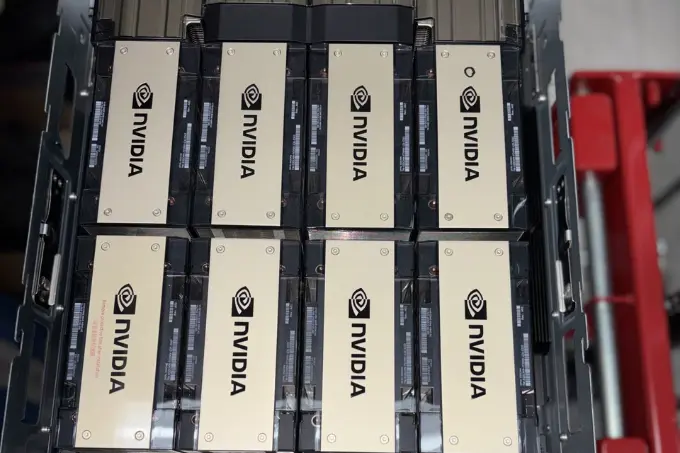
GPUs are the most sought-after components in the secondary market. They power the most demanding AI workloads, from model training to real-time inference. These assets are expensive to source.
As enterprises refresh their fleets and move to next-gen hardware such as NVIDIA Blackwell, older GPUs like A100 and H200 are flowing into the secondary market in growing volumes.
Compute Nodes
Compute nodes are the building blocks of any HPC cluster. They house the processors, memory, and local storage that distribute workloads across a system.
When a large enterprise decommissions a cluster, entire racks of compute nodes enter the market, often in good condition and with years of useful life remaining.
High-Speed Networking Equipment
High-speed networking equipment, particularly InfiniBand switches and adapters, allows GPUs to communicate with near-zero latency during distributed training runs.
InfiniBand is used in over 70% of AI and machine learning data centers, making it one of the most critical infrastructure components. But new InfiniBand switches can cost between $5,000 and $20,000 per unit, and lead times follow the same constraints as GPU hardware.
How Inteleca Helps Organizations Buy and Sell HPC Hardware Through the Secondary Market
Most secondary market vendors operate on one side of the transaction. They either resell hardware or they decommission it. They don’t do both.
Inteleca is an R2v3-certified HPC solutions provider that operates across the full hardware lifecycle. We source and sell certified pre-owned hardware to organizations that need it. And we decommission and remarket hardware from organizations that are done with it.
That dual model gives us something most resellers don’t have: real-time visibility into both supply and demand. When we price an H100 server for a buyer, we’re not pulling from a catalog. We’re pricing against what our network is actively trading right now.
Our buyer network spans 91 countries. H100 and H200 GPUs, HGX baseboards, A100 8-GPU servers from Dell, Supermicro, and ASUS, A6000 and A40 accelerators: all moving at volume through direct relationships with end buyers. Not broker chains.
Here’s how we work with organizations on both sides of the market:
Certified Pre-Owned HPC Procurement
We source enterprise-grade GPUs, servers, and networking equipment from major brands like NVIDIA, AMD, Dell, HPE, Lenovo, and Supermicro. Every unit gets tested and validated in-house before it ships. We back all hardware with a warranty.
Because we handle decommissioning for enterprises and data centers directly, much of our inventory comes from production environments where the hardware ran demanding workloads for years. You’re not buying from a broker who bought from another broker. You’re buying from the team that pulled it from the rack, wiped it, tested it, and certified it.
HPC Equipment Buyback
If you’re upgrading to next-gen hardware, we purchase your surplus GPUs, servers, and networking gear directly. You get a fair valuation based on live market demand, fast turnaround, and secure handling from pickup through final sale.
This gives you a compliant channel to recover value from retired infrastructure instead of letting it sit on the floor and depreciate.
Secure Decommissioning
Our in-house team handles de-racking, data erasure using Blancco, and on-site pickup. No subcontractors. Every asset is processed to R2v3 and NIST data sanitization standards under a single chain of custody.
You receive a certificate of data destruction, a full asset inventory with serial-level identifiers, and chain-of-custody documentation for every piece of equipment.
Upgrading your HPC infrastructure? Connect with Inteleca to find out what certified pre-owned options can cut your procurement timeline from months to days, and what your surplus equipment is worth in today’s market.