Why Data Center Consolidations Are Reshaping the Secondary Hardware Market
Your company just decided to migrate core workloads to the cloud. That means shutting down server rooms, storage arrays, and networking gear your team has managed for years. The migration plan covers every workload. But what happens to the hardware in those racks?
This is happening at scale. Data center consolidations such as cloud migrations, Mergers & Acquisitions, and AI infrastructure upgrades are flooding the secondary hardware market with enterprise-grade equipment. But many organizations have no disposition plan for these assets.
This article covers what drives consolidations, how they reshape the secondary hardware market, and what organizations should consider when planning asset disposition during these transitions.
Key Insights
- Data center consolidations driven by cloud migrations, M&A, and AI infrastructure upgrades are flooding the secondary hardware market with enterprise-grade equipment.
- Hardware value fluctuates, making timing and planning critical to recovery.
- Unplanned disposition creates three compounding risks: data breaches, physical asset damage, and compliance exposure.
- A component-level inventory audit before decommissioning begins is a huge factor in recovery value.
- Each asset needs a defined disposition path: resale, redeployment, refurbishment, recycling, or destruction.
- Organizations that build ITAD planning into the migration timeline consistently recover more asset value than those that treat it as a cleanup task.
- Inteleca helps organizations decommission, refurbish, and remarket high-performance computing (HPC) hardware during consolidations to recover maximum asset value.
What Is Driving Data Center Consolidations Right Now
The forces driving consolidation aren’t new, but they’re hitting at the same time. Cloud pressure, M&A activity, and AI infrastructure demands are all pushing organizations to shrink their physical footprints simultaneously. The result is more decommissioned hardware entering the market than most disposition programs were built to handle.
Several forces are driving it:
Cloud Migration and Infrastructure Downsizing
Cloud migration is one of the biggest drivers of data center consolidation. When an enterprise moves core workloads to the cloud, physical data centers become overhead.
Facilities are consolidated, leases get terminated, and racks of servers, storage arrays, and networking gear are sold in bulk to clear out the space.
Mergers and Acquisitions
When two companies merge, they may not need two data centers running in parallel. The acquiring company standardizes on one infrastructure stack, while the other is shut down or migrated. Servers, storage systems, and networking equipment from the absorbed entity are decommissioned, often on tight timelines set by integration teams trying to cut costs quickly.
According to the S&P Global Market Intelligence report, data center M&A totaled over $69 billion in deal value in 2025 alone. This means hardware is entering the secondary market in bulk, fast, and often without a recovery plan in place.
AI Readiness and Infrastructure Incompatibility
Legacy data centers were built for workloads drawing 5 to 10 kW per rack. AI compute racks now demand 20 to 60 kW, with hyperscale environments pushing past 100 kW. More than 35 GW of data center capacity is currently under construction in North America alone to meet that demand.
As new facilities come online, older infrastructure is retired to make room, and the hardware inside it flows into the secondary market.
Compressed Hardware Refresh Cycles
AI is shortening the useful life of enterprise hardware. HPC GPU infrastructure traditionally ran for five to seven years before replacement. AI-driven refresh cycles have compressed that window to 18 to 36 months.
Each refresh wave pushes functional hardware into the secondary market, often before the organization has a disposition plan in place.
Cost Reduction and Facility Rationalization
Organizations facing budget pressure are consolidating facilities, exiting leases early, and shifting workloads to more cost-efficient environments such as neocloud providers. They want to reduce fixed infrastructure costs and convert capital expenditure into a more predictable operational model.
Business Closures and Distressed Liquidations
When a company shuts down or files for bankruptcy, data center hardware is treated as a liquidatable asset. Creditors and administrators prioritize speed over value recovery. Equipment is auctioned in bulk, often without certified data destruction, proper grading, or any assessment of secondary market value.
This creates two problems that suppress the hardware’s resale value:
- The organization leaving the market recovers far less than the hardware is worth.
- And the hardware entering the secondary market through distressed channels often lacks the documentation buyers need to verify its condition and data sanitization status.
How Consolidations Are Reshaping the Secondary Hardware Market
When consolidations happen at scale, large volumes of enterprise-grade hardware enter the secondary market at once. This has shaped the entire market trend. Buyers now have more options, which gives them negotiating leverage, while sellers are forced to sell hardware at a lower price.
This is why timing is critical, because hardware value can erode quickly once a consolidation closes. Buyers compare decommissioned assets against what they can source today, how quickly it deploys, and how much uncertainty comes with it.
Some IT teams bulk-sell assets to refurbishing partners without knowing each component’s market value to meet the closing deadlines. But if enterprise servers are from recent generations, GPUs and networking equipment with remaining lifecycle value can still recover a meaningful portion of their original cost.
Recently, memory modules have been particularly strong in the market. Many enterprises are looking for DDR4 server modules from decommissioned fleets due to the production halt. This makes the secondary market one of the few reliable sources left for these components.
But most organizations don’t have a formal plan or secondary market knowledge to determine what happens to hardware when a consolidation closes.
The Risks of Unplanned Asset Disposition During Consolidations
Most IT teams focus on migration during a consolidation. Workload cutover dates, lease exits, and system validations consume the project timeline. And hardware disposition is either added to the plan late or rushed at the last minute.
This leads to three risks:
Improperly Disposed Hardware Creates Data Breach Risk
Every server, storage array, and drive in a decommissioned facility holds sensitive data. When companies rush to disposition, they skip the data destruction steps that mitigate data security risks.
For example, a third-party storage vendor improperly disposed of hard drives containing patient records. The breach exposed the protected health information of 116,898 patients, including Social Security numbers, financial account details, lab results, and treatment records.
Rushed Rack Pulls Destroy Physical Asset Value
When teams compress decommissioning timelines, they rush rack pulls instead of doing a proper asset recovery operation. They crack drive trays, misplace cables, and pack components carelessly. This reduces recoverable value because buyers in the secondary market grade hardware based on its arrival condition.
No Formal Program Means No Compliance Protection
Most teams don’t document data destruction with clear ownership or accountability during disposal. NIST guidelines require data sanitization to be part of a formal, organization-wide program aligned with broader cybersecurity frameworks.
Organizations that treat disposition as a cleanup task face audit risk when regulators ask for documentation.
How ITAD Planning Maximizes Asset Value Recovery During Consolidations
IT teams usually treat disposition as a cleanup task. That’s a mistake. By the time decommissioning starts, the decisions that determine recovery value have already been made or missed.
Here’s how to plan it right.
Audit Your Hardware Inventory Before the Migration Starts
Document every asset by make, model, age, and condition before a single rack gets cleared. Servers, storage arrays, GPUs, networking gear, and memory modules all carry different residual values.
Internal teams skip this or grade hardware against depreciation schedules. That’s not what the secondary market pays. A two-year-old GPU server may be fully depreciated on your books and still command strong resale value to an active buyer. Without a component-level audit, you have no baseline to know the difference.
Build an ITAD Plan Alongside the Migration Plan
Set your disposition timeline the same day you set your migration timeline. Every workload cutover date, lease exit, and facility closure has a hardware implication. Mapping these dependencies early gives your ITAD partner enough lead time to assess, recover, and clear assets without rushing the process.
Classify Every Asset Into a Clear Disposition Path
Assign each asset one of five paths: resale, internal redeployment, refurbishment, certified recycling, or destruction. Each path carries a different recovery potential and compliance requirements.
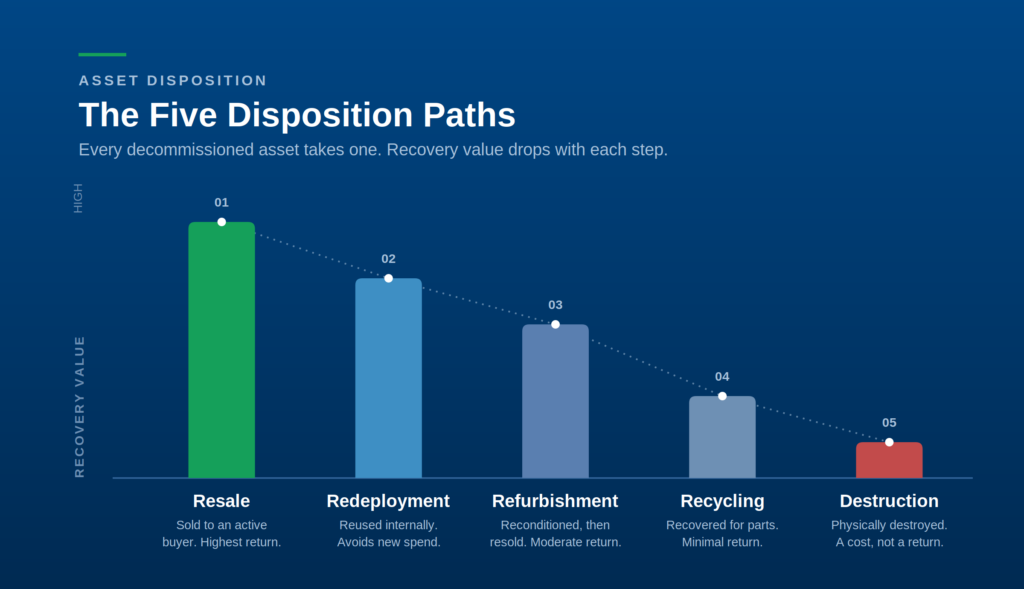
A GPU server routed to an active buyer network returns far more than the same unit bulk-recycled because no one classified it.
Components matter too. Sometimes a server’s GPUs, memory modules, or drives are worth more stripped and sold separately than the unit is whole.
Wipe Out Data Residue Before Hardware Leaves Your Facility
Every drive, SSD, and memory module holds sensitive data. Deleting files only removes file system pointers. The underlying data stays on the disk and is recoverable with freely available tools.
Complete certified data destruction on every asset before it moves off-site. Your ITAD partner should provide a documented chain of custody that starts the moment a device is tagged for decommission.
Understand Your Assets’ Secondary Market Value
Most ITAD vendors sell through broker chains. Multiple intermediaries take a cut before the asset reaches an end buyer. Each handoff negotiates the price down.
Secondary market value also moves fast. An H100 GPU holds a strong resale value today. Once newer architectures ship in volume, that window closes. But most ITAD vendors don’t have enough knowledge to tell you what buyers are looking for or willing to pay for.
Consolidations Are Not Slowing Down
AI infrastructure upgrades, cloud migrations, and compressed refresh cycles mean consolidation volume will keep increasing. More hardware will enter the secondary market, and buyer leverage will grow with it.
Every consolidation is either an asset recovery opportunity or a missed one. The difference is whether ITAD is built into the project plan from day one or treated as a cleanup task at the end.
Inteleca builds the ITAD process into the consolidation timeline from day one. We operate on both sides of the hardware lifecycle: as a decommissioner and seller.
Our in-house team sources and sells hardware into the same buyer network we remarket your decommissioned assets through. That gives us real-time demand signals that a recycle-first vendor simply doesn’t have.
We handle every step from rack pull to resale under a single chain of custody without third-party handoffs that introduce compliance gaps.
If your consolidation is in planning, the recovery window is still open. Book a consultation to learn how we build an asset recovery plan around your timeline.