AI and the Data Center: A Look at the Early Impact
When it comes to tech talk, there don’t seem to be many conversations these days that don’t revolve around the use of Artificial Intelligence (AI) or its impact. From the broad world of digital transformation to the more focused threads IoTand human interaction—whatever the case, AI is at the core of the new modern world.
But aside from all of the cool forward-facing things that AI can do, the focus must also be channeled inwards towards the data center itself. After all, though the end-user stiffis cool, none of it happens without the data center itself being involved. So with that said, the question becomes how is the data center going to be impacted by AI?
Key Takeaways
- AI is already delivering measurable energy savings in data center operations, as demonstrated by Google’s AI system managing over 120 variables across cooling and fan systems to achieve more than 40% in energy cost reductions.
- Predictive analytics powered by AI is making server load balancing and optimization significantly more efficient, translating directly into cost savings as businesses better manage server capacity and performance.
- AI-driven cybersecurity monitoring addresses a critical gap that human teams alone cannot fill, using predictive analysis to detect anomalies in network behavior and identify threats in real time rather than relying on manual, second-by-second oversight.
- IoT-enabled monitoring is beginning to track the physical condition of data centers themselves, alerting staff to issues like failing cables, loose connections, or cooling system problems before they cause unplanned downtime.
- Successfully implementing AI-driven data center improvements, from energy efficiency to predictive maintenance, requires partnering with experienced professionals who understand data center architecture, design, and operations from the ground up.
For one, AI is already helping data centers become far more energy efficient—something that all businesses should be concentrating on as both a money saver and a planet saver. A perfect example of this is Google and how they are using AI to manage their data centers—an AI system that controls more than 120 variables, including everything from cooling systems, fans, and more that has reportedly saved them more than 40% in energy costs. To put that into context, Google used more than 4,000,000 MWh of power in 2014—meaning that 40% amounts to a lot of green (pardon the double entendre).
However, that is just the beginning. With server optimization being something that also translates to money well earned, the influx of AI to manage server inefficiency is becoming mainstream. AI-based predictive analytics and the ability to act on those analytics are making it easier for companies to manage load balancing far more efficiently.
And of course, no one can talk AI and the data center without bringing up the hot and ever-present topic of cyber security. With looming threats on a literal second-to-second basis, it’s impossible for human beings to remain at the helm 24/7—the ever-evolving stream of information being impossible to keep up with. This is where AI comes in. To manage the speed at which environments and threats evolve, AI again uses predictive approaches and analysis to monitor potential threats in real time—looking for changes in normal network behaviorto mitigate the risk of threats.
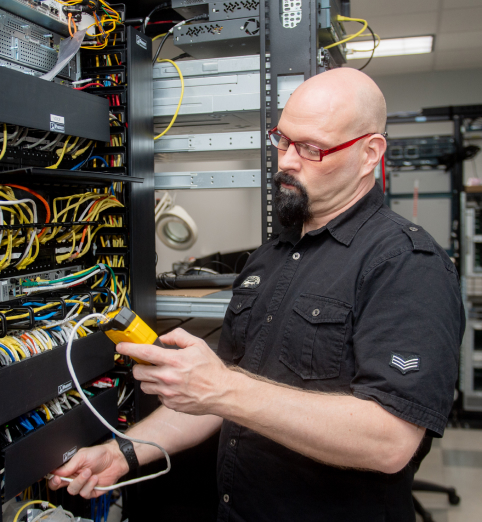
But what about the actual human element itself associated with data center maintenance? This is again where AI will begin to shine. As mentioned in the beginning, it’s hard to have any conversation these days around any of these topics without the Internet-of-things being at the center of it all. But IoT’s possibilities are not just focused on the end-user side of business. In the case of data centers, technology is being developed using IoT devices that will help monitor the actual physicality of the datacenter itself—alerting staff to everything from bad cables and loose connections, right down to issues with heating and cooling systems, and building infrastructure. The result? Down time is about to become greatly reduced—at least due to faulty hardware and building systems. Imagine knowing when a cable is failing before it fails, or a cooling system that needs maintenance before it shuts down completely.
In all, it’s a bright future ahead for IT. From the implications of new and exciting end-user experiences that make everything in our collective daily lives highly personalized and unique, to the infrastructure that supports those experiences—whatever the case, AI will be at the forefront of the modern IT world. The only question becomes, how and where does anyone begin to implement these types of solutions? Simply put . . . find a partner that lives and breathes data center technology—from architecture and design all the way through to building and beyond.
It’s never difficult to be on top of this type of technology—as long as the professionals are by your side every step of the way.
FAQs
How is AI helping data centers become more energy efficient?
AI is helping data centers reduce energy consumption by managing complex systems like cooling and airflow with far greater precision than manual oversight allows. Google’s well-known example involves an AI system controlling more than 120 variables across their data centers, resulting in over 40% in energy cost savings. As AI workloads themselves place growing power and cooling demands on data centers, optimizing infrastructure to handle these intensive requirements has become essential, often requiring advanced solutions like liquid cooling to manage the heat generated by high-density AI processing.
How does AI improve cybersecurity monitoring in data centers?
AI addresses a critical limitation in cybersecurity: the impossibility of human teams monitoring every second of network activity around the clock. Using predictive analytics, AI systems can continuously analyze network behavior, flag anomalies, and identify potential threats in real time as they emerge, rather than relying solely on manual detection after the fact. This kind of continuous, automated oversight is increasingly paired with 24/7 monitoring services that use predictive tools to catch issues before they escalate into serious security incidents.
What infrastructure challenges does AI create for data centers?
AI workloads place substantially higher demands on data center infrastructure than traditional computing, particularly around power consumption and heat generation. High-performance AI processing requires advanced cooling solutions, since traditional air-cooled systems often can’t keep pace with the heat generated by dense AI hardware, pushing more data centers toward liquid cooling systems capable of handling significantly higher wattage per socket. Businesses building out AI capabilities need to plan for these infrastructure demands as a core part of their strategy rather than an afterthought to the AI applications themselves.