Why Third-Party Maintenance Is Becoming More Relevant During Cloud Migration Transitions
When you’re mid-migration, you’re paying for two environments at once. Cloud costs start the moment replication and testing begin. On-premise costs don’t stop until the last workload migrates. This is the double bubble, and it costs more than most migration budgets account for.
But migrations can go slower than planned. According to a report, 27% of enterprises report delays in the migration timeline. Throughout that extended window, on-premise hardware needs maintenance coverage at full OEM rates.
Most of that cost is unavoidable. You can’t cut cloud spend during active replication. You can’t compress cutover timelines. But on-premise maintenance is different. It’s the most controllable line item in the overlap period. And most organizations are still paying full OEM rates on hardware they plan to retire.
Key Insights
- The hardware that stays on-prem longest is usually the most critical and hardest to migrate, yet OEM contracts don’t flex to cover only the remaining useful life.
- OEM end-of-support notices arrive on the vendor’s schedule. Renewing a contract on hardware you plan to retire within a year is paying a premium for a depreciating asset.
- Third-party maintenance offers flexible contracts that align with migration timelines, covering multi-vendor environments under one agreement at a fraction of OEM post-warranty pricing.
- A TPM provider should confirm parts availability for your exact hardware models, offer SLA flexibility by tier, and adjust coverage as hardware is decommissioned.
- Inteleca provides IT maintenance for enterprises and data centers that run mixed environments and want to offset migration costs.
Why Cloud Migrations Create a Hardware Maintenance Problem
Phased migrations move workloads in stages. Some systems migrate early. Others stay on-prem for months because of application dependencies, compliance holds, or hard-coded configurations that don’t translate cleanly to cloud infrastructure.
The hardware that stays is usually the most critical. Databases, financial systems, and compliance-sensitive workloads are scheduled last because they’re the hardest to move. That remaining on-prem fleet is operational, needs support, and generates a maintenance cost.
But OEM contracts don’t flex with migration timelines. A 3-year Dell or HPE support agreement doesn’t care that your hardware has 14 months of useful life left. You end up paying for coverage you won’t fully use.
How OEM Timelines Add Pressure to an Already Tight Budget
OEM end-of-support notices arrive on the vendor’s schedule, not yours. They expect you to upgrade to the next generation. But if you’re moving to the cloud, refreshing hardware exhausts your budget.
Post-warranty OEM pricing increases in the later lifecycle stages. Renewing that contract means paying a premium for an asset you’re planning to retire. It’s a poor trade.
And the hardware itself isn’t the problem. Servers and storage arrays running past OEM support windows continue to perform reliably. The vendor stops supporting the product because they want you on the next generation.
Replacing the hardware isn’t better either. Buying replacement hardware for infrastructure you’ll decommission within a year is capital misallocation at historically bad prices.
So most IT teams feel squeezed between three bad options: pay inflated OEM renewal, buy expensive new hardware, or drop maintenance coverage and accept the risk.
Third-Party Maintenance Is a More Affordable Option for Cloud Migration Transitions
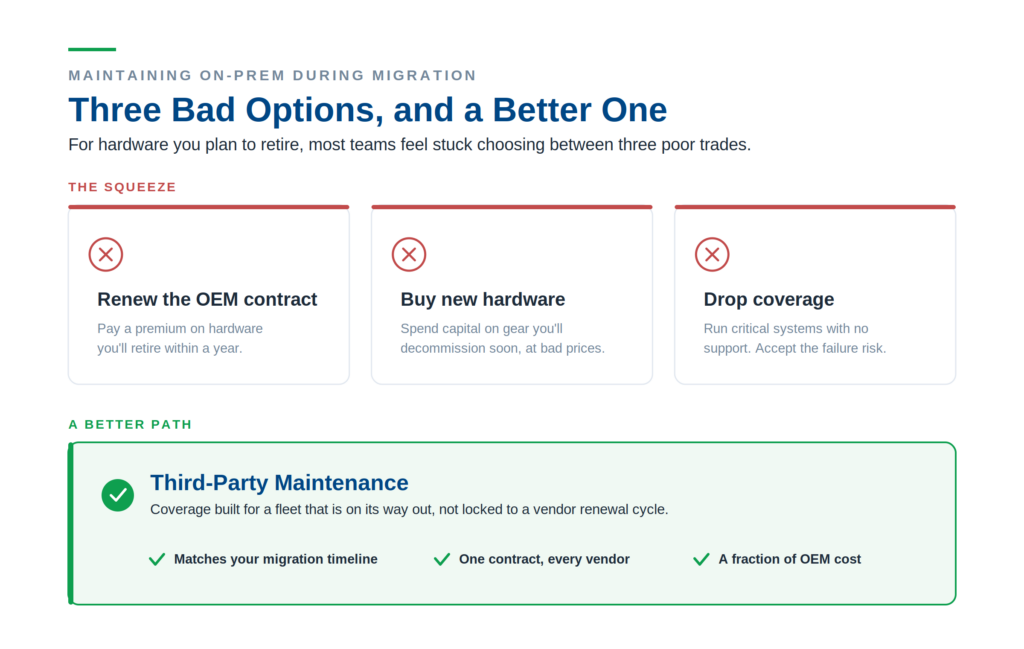
Third-party hardware maintenance (TPM) is a flexible option for enterprises migrating to the cloud. Unlike OEMs, their contract terms align with migration timelines. You can sign for 12 months, 18 months, or quarter-by-quarter, and end coverage once migration is complete.
Third-party hardware maintenance providers also support mixed environments under one contract. For example, if your on-prem fleet includes servers, storage arrays, and switches, one agreement covers all. No multiple support relationships to manage while your team is already stretched across the migration.
This helps enterprises reduce server maintenance costs. You’re no longer paying full post-warranty OEM rates on hardware you plan to retire. And the recovered budget can go straight toward cloud migration costs.
The support itself holds up. TPM providers deliver Tier 1 through Tier 3 coverage with SLAs that match or exceed most OEM post-warranty contracts. Response times are often faster because tickets don’t route through OEM support tiers before reaching someone who can act.
How to Evaluate a TPM Provider During Cloud Migration
Not every third-party maintenance provider is built for a migration scenario. Some are structured around long-term lifecycle extension. Others lack parts inventory for the specific hardware models enterprises run at the tail end of a migration.
Here’s what to evaluate before signing.
Parts Availability for Your Specific Fleet
Make sure the third-party hardware maintenance provider has your exact hardware models before signing anything. At the tail end of a migration, the remaining fleet is usually the oldest and hardest to source parts for.
If a critical component fails, the provider has to source it externally. At that point, your contract becomes a best-effort promise. That’s operational risk at the worst possible time, when your team is already split between keeping on-prem systems running and pushing the migration forward.
SLA Flexibility by Tier
Not every remaining system carries the same risk. A mission-critical database needs a 24/7 four-hour response. A file server migrating next quarter may only need next-business-day coverage. A provider applying one blanket service-level agreement (SLA) across your entire fleet will either over-serve low-risk equipment or under-serve what actually matters.
Ramp-Down Capability
As workloads migrate and hardware gets decommissioned, your maintenance contract should shrink with it. Ask whether the TPM provider adjusts coverage as your fleet decreases.
A provider with ramp-down capability adjusts the contract as systems go offline. So your maintenance spend tracks your actual migration progress instead of a fixed number you agreed to on day one.
How Inteleca Supports Cloud Migration as a Maintenance Partner
Most cloud migration plans account for cloud costs, workload sequencing, and cutover dates. Very few account for what happens to on-prem maintenance costs during the overlap.
Inteleca is both an IT maintenance provider and an active decommissioning partner. We keep your on-premise environment running during the transition, and we decommission it responsibly when migration is complete.
Our maintenance plans cover multi-vendor environments under one flexible contract, with 24/7 monitoring, hardware repair and replacement, and Tier 1 through Tier 3 support.
Once hardware comes offline, our in-house team handles secure data destruction, chain-of-custody documentation, and asset remarketing, so you recover value instead of paying for disposal.
Here’s how we help you operate in mixed environments:
24/7 Monitoring and Support
Our operations center monitors your entire remaining on-premise network around the clock. We detect issues before they become failures, produce automatic service requests, and alert our team immediately when incidents occur.
For urgent problems, our engineers provide Tier 2 and Tier 3 support with on-site response if necessary. Your IT team also gets direct visibility through a secure client portal, so nothing is a black box during the transition.
Flexible Contract Terms
We structure contracts around your migration timeline, not a vendor renewal cycle. You can choose a term: 12 months, 18 months, or shorter. As workloads migrate and hardware comes offline, coverage adjusts with it. You’re not locked into paying for systems you’ve already decommissioned.
Certified Decommissioning
Our in-house team uses R2v3 and NIST (National Institute of Standards and Technology) standards to wipe out sensitive data. Every asset is tracked and documented for a full chain-of-custody.
We then recycle or repurpose every component and hardware asset based on their lifespan and secondary market value.
Hardware Buyback Program for Maximum ROI
We assess your refurbished surplus equipment against what our global buyer network is actively trading. We price every asset based on the current market demand.
That recovered budget can offset cloud migration costs, turning hardware retirement from a sunk cost into a financial return.
Stop paying full OEM rates on hardware you’re retiring. Book a call with Inteleca to learn how you can reduce your on-prem maintenance costs during the transition.